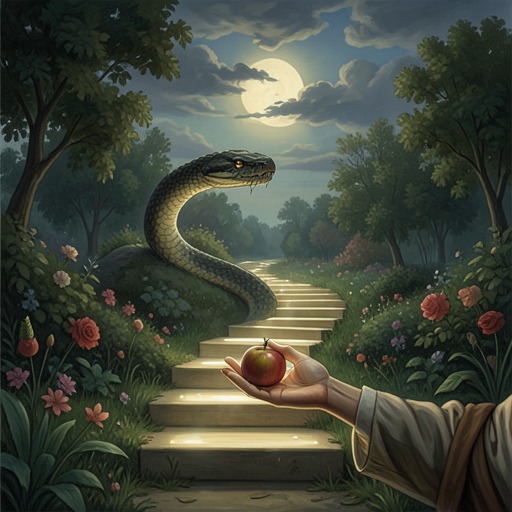
Satan and Eve
Paradise LostSatan and Eve is one of the poem’s decisive relations: it joins Satan’s revenge against God to Eve’s desire for knowledge, converts a harmless creature into an instrument of fraud, and makes private persuasion the mechanism by which the whole human race is drawn toward ruin. Their encounter is not an equal exchange but a carefully engineered relation in which Satan selects Eve when she is separated from Adam, studies the form most likely to disarm her, and turns the language of freedom, reason, and advancement against the command that defines her obedience.
Satan’s Objective and the Serpent’s Body
Satan’s approach to Eve follows directly from his earlier resolve to injure the new human creation as a way of striking at its Maker. He regards the world made for Man as a rival gift and resents that a creature formed from Earth has been elevated, endowed with dominion, and attended by angelic ministers. Because he fears Adam’s greater intellectual power, heroic courage, and bodily strength, he deliberately seeks Eve alone. The relation therefore begins with tactical judgment: Satan does not merely encounter Eve; he chooses the circumstance in which she can be reached most effectively.
To accomplish this purpose, Satan descends into the form of the serpent, accepting a degradation that mirrors the logic of his rebellion. He once aspired to contend with Gods and sit highest; now he is willing to incarnate himself in a beast and mingle his essence with bestial matter. His ambition and revenge drive him downward, and the descent is itself presented as morally self-defeating: revenge may first seem sweet, but it recoils upon the avenger. Yet Satan accepts that recoil because destroying Man would damage the favorite creature of Heaven and thereby give him infernal glory.
The serpent’s appearance makes fraud possible. He does not approach Eve as a visibly hostile power, but as a beautiful and unusually graceful creature, erect upon coiled folds, with a raised crest, bright eyes, and a burnished green-gold neck. His gestures are calculated before speech begins: he winds through the garden, bows his head, smooths his neck, fawns, and licks the ground where Eve has walked. The body becomes an argument before the argument is spoken. Its loveliness and apparent gentleness encourage Eve to interpret danger as wonder and submission as admiration.
Isolation, Praise, and the Opening of Speech
Eve’s separation from Adam arises from an ordinary division of labor rather than from an initial act of rebellion. She proposes that they work apart because the Garden has grown beyond what two gardeners can manage, and she believes that unsought trial may find them less prepared than a trial deliberately faced. Adam warns her that temptation should be avoided and that obedience, rather than a desire to display constancy, is the true test. Eve nevertheless withdraws her hand from his and goes alone among the groves, promising to return by noon.
Satan has been searching for precisely this opportunity. He hopes to find Eve separate, and when he sees her among the roses, absorbed in tending flowers whose delicate stems require support, his design momentarily falters. Her beauty and innocence disarm his hatred; for a short interval he is separated from his own evil and remains, in the poem’s striking reversal, almost good. The pleasure is impossible for him to sustain. The sight of what is not ordained for him intensifies his torment, and hatred, envy, and revenge return with greater force.
The serpent then turns admiration into flattery. He addresses Eve as a sovereign wonder, suggests that all living things should behold and adore her, and implies that Adam alone is insufficient as an audience for her excellence. The praise is not incidental ornament. It isolates Eve symbolically as well as physically, encouraging her to imagine a status beyond the limits of her present relation and to regard universal admiration as her proper due. Satan’s rhetoric also presents his approach as respectful: he appears to honor the very hierarchy he is preparing to overturn.
Eve is astonished that a brute can speak with human sense. Her question gives Satan the opening he needs, and he answers by inventing a personal history. He claims that he was once an ordinary beast until he tasted fruit from another tree, after which he gained reason, speech, and the capacity to contemplate the visible universe. He presents his supposed transformation as experiential proof: he tasted, lived, and became more perfect. The story makes the serpent a seemingly trustworthy witness because he speaks as one who has already survived the forbidden act.
The Rhetoric of Knowledge and Freedom
The relation becomes openly adversarial when Satan directs Eve to the Tree of Knowledge of Good and Evil. Eve accurately states the command: she and Adam may eat from every other tree, but they must not eat or even touch the fruit of this tree lest they die. Her language shows that the prohibition is known and specific. Satan does not need to reveal a forgotten rule; he must reinterpret a clear one.
His counterargument proceeds through a sequence of provocations. He denies that the fruit will bring death, points to his own continued life, and claims that tasting has given him a higher degree of existence. He asks why knowledge available to a beast should be closed to Man, and he recasts the prohibition as evidence that God wishes to keep human beings low and ignorant. The command is thus made to appear not protective but jealous, not an expression of rightful authority but an attempt to prevent equality. Satan’s language borrows the vocabulary of liberty while concealing the manipulation by which he directs Eve’s choice.
He also attacks the coherence of divine justice. If God is just, Satan argues, God cannot punish the pursuit of knowledge; if God forbids the fruit because it grants godlike understanding, then the prohibition reveals envy rather than wisdom. This is a false dilemma, but it is rhetorically powerful because it makes disobedience appear intellectually courageous. Satan places the appeal to reason beside the appeal to pride, inviting Eve to prove herself free by refusing the condition under which freedom has been given.
Eve’s response shows how thoroughly the argument has entered her thought. She gazes at the fruit, recalls its name as the Tree of Knowledge, and reasons that an unknown good is effectively not possessed. The prohibition seems to commend the fruit by announcing its value. She asks what benefit inward freedom can have if death follows, but the serpent’s survival supplies the apparent answer. In this interior debate, Satan’s voice continues even when he is no longer speaking aloud: his claims have become the premises of Eve’s own reasoning.
The Act and the Transfer of the Relation
Eve finally reaches for the fruit and eats. The act is represented as a wound to the Earth, with Nature sighing through its works, so the relation between Satan and Eve immediately exceeds their private encounter. Satan’s intended injury to God becomes a disturbance in the created order. Eve experiences the fruit as intensely pleasurable and imagines that it has opened her mind to wisdom, while the narration makes clear that her delight is bound to expectation and deception rather than to the promised godhead.
After eating, Eve’s first sustained concern is not simply whether she has gained knowledge but how she will stand in relation to Adam. She considers keeping the advantage to herself in order to become more equal, perhaps even superior, but the possibility of dying while Adam lives with another Eve terrifies her. Her love for Adam determines her final choice. She resolves that he must share her fate, believing that bliss without him would be no bliss and that a divided degree of knowledge might divide their union.
When Eve meets Adam, she approaches with a branch of fruit and an explanation already shaped as an apology. She tells him that the serpent became rational and articulate through tasting, that the threat of death has not been fulfilled, and that she has experienced widened perception and an enlarged heart. She emphasizes that she sought this transformation chiefly for Adam, because happiness unshared with him would be tedious and odious. The rhetoric that Satan used to make Eve desire godlike knowledge is now transmitted through Eve’s love, turning their intimate bond into the next instrument of temptation.
Adam recognizes the fatal trespass immediately. His garland falls from his hand, its roses scattering as he stands stunned and pale. Yet his horror does not lead him to separate himself from Eve. He decides to share her doom, reasoning that she is flesh of his flesh and bone of his bone, and that to lose her would be to lose himself. Eve then interprets his decision as the highest proof of love and accepts one guilt and one crime with him. Satan’s relation with Eve therefore becomes a relation between Eve and Adam: the original deception is reproduced as shared solidarity, but that solidarity now carries disobedience into the human pair.
Judgment and the Larger Consequences
The aftermath reveals the asymmetry between Satan’s manipulation and Eve’s accountability. Before judgment, Adam attempts to explain that Eve gave him the fruit, but the divine response exposes the evasion in his appeal: Eve was not his God, superior, or proper guide. Eve in turn confesses that the serpent beguiled her. The exchange assigns responsibility without erasing the relational pressures through which the act occurred. Satan supplied the fraud, Eve accepted it, and Adam chose to follow her rather than obey the command.
The judgment on the serpent transforms the temporary disguise into a lasting sign of hostility. The serpent is cursed above the beasts, condemned to crawl and eat dust, and placed in enmity with the Woman and her seed. The punishment therefore preserves the memory of the encounter in the structure of later relations: the creature that served Satan becomes the emblem of conflict between the serpent’s line and humanity. The promised bruising of the serpent’s head also gives the encounter a future dimension, announcing that Satan’s apparent victory will contain the prophecy of his eventual defeat.
The relation’s deepest consequence is that Satan succeeds in making Eve’s transgression the entrance of sin into human history, but not in securing the final destruction he desires. The poem’s larger theological structure answers Satan’s revenge with a counter-economy of sacrifice and grace. God declares that Man will die unless another, both able and willing, pays death for death; the Son of God offers life for life, accepts incarnation and death, and promises resurrection. The Son’s obedience and sacrifice will defeat Sin and Death, bruise Satan’s head, and redeem those who receive the benefit by Faith. Satan’s manipulation thus produces real loss, mortality, and judgment, yet the consequences are folded into a providential design in which evil is made to yield a greater good.
Satan and Eve therefore embodies a central tension between freedom and deception. Eve is free to choose, and the poem insists that genuine allegiance requires such freedom; nevertheless, her choice is shaped by isolation, sensory attraction, false testimony, ideological flattery, and a counterfeit account of justice. Satan presents himself as the champion of liberty while pursuing domination over Eve’s understanding. Eve seeks knowledge in the name of enlargement, but the encounter instead exposes how easily the desire to become more than one is can be redirected into dependence upon another’s lie. The relation is consequently both intimate and political: a serpent’s persuasive voice reaches one woman in a garden, and through her decision alters the condition of Man, while the promised answer to that alteration reaches from the first transgression to redemption and the final defeat of Satan.